Tuesday, October 1, 2024

The Power of Music to Shape History - The Legacy of Dhadis in Punjab

Image source: https://x.com/SocietySikhi/status/907344153838792704

In the vibrant tapestry of Punjab’s cultural heritage, the Dhadis stand out as traditional minstrels and bards, known for their distinctive style of singing and mastery of the dhadd, a small yet powerful percussion instrument. These talented artists narrate heroic tales, historical events, and moral stories through their performances, weaving narratives that resonate deeply with the audience. The term "Dhadi" itself is derived from the instrument they play, often accompanied by the sarangi, another melodic string instrument that adds depth to their storytelling.

History of Dhadis in Punjab

The Dhadi tradition is deeply entrenched in the Punjabi oral tradition, with roots that trace back centuries. Originally, Dhadis performed at the courts of kings and nobles, where they would recount ballads of bravery and valor. This art form served not just as entertainment but as a means of preserving history and instilling cultural pride among the people. Over time, the tradition became an essential part of Punjab's cultural fabric, celebrated for its role in keeping historical and folk tales alive.

Connection with Sikhism

The Dhadis gained particular prominence during the era of Guru Hargobind Ji, the sixth Sikh Guru, who reigned from 1606 to 1644. Recognizing the potential of music to inspire courage and resistance against oppression, Guru Hargobind Ji encouraged Dhadis to sing ballads of Sikh warriors and recount the battles fought for justice. His vision of Miri-Piri—the harmonious coexistence of spiritual and temporal authority—underscored the importance of both faith and valor, which the Dhadis embodied through their performances.

As they began performing vaars (heroic ballads), Dhadis narrated stories of Sikh bravery, martyrdom, and key historical events from the lives of the Sikh Gurus. These narratives included the legendary battles against the Mughal Empire, where the valor of Sikh warriors was immortalized through song. Such performances became integral to Sikh congregations and were regularly featured in gurdwaras (Sikh temples), especially during significant religious occasions.

Evolution in Sikh Tradition

Dhadis have played a crucial role in preserving Sikh history through the art of oral storytelling. Their performances serve as living chronicles of significant events, such as the martyrdom of Guru Arjan Dev Ji and the valiant endeavors of Guru Gobind Singh Ji. The Dhadis narrate tales of the Khalsa army, emphasizing the sacrifices made for the faith and the fight for justice.

While traditionally linked to the ethos of Sikh warriors, Dhadis also convey the spiritual teachings of the Sikh Gurus, intertwining messages of valor with profound spiritual wisdom. Their performances are not only an essential part of Sikh ceremonies and festivals, including Gurpurabs (celebrations of the birthdays or martyrdoms of the Gurus), but they also reinforce the collective memory of the Sikh community.

Modern Context

In the contemporary landscape, Dhadi Jathas (groups of Dhadis) continue to perform in gurdwaras and cultural events across Punjab and the global Sikh diaspora. They are viewed as the custodians of Sikh culture and history, reminding audiences of the bravery, sacrifices, and spiritual values that are integral to Sikh identity. Their performances resonate with both young and old, bridging the gap between generations and instilling a sense of pride in their rich heritage.

Despite the profound contributions of Dhadis to Sikh culture, awareness of their history and significance has diminished in recent years. Many people remain unaware of the crucial role Dhadis have played in shaping the Sikh narrative, and it is essential to recognize and celebrate this unique tradition.

In conclusion, the legacy of Dhadis is a testament to the enduring power of music and storytelling. As we navigate the complexities of the modern world, we must not forget the rich history of these minstrels and the messages they convey. The Dhadis serve as a reminder of our shared values, inspiring us to embrace our heritage and acknowledge the stories that have shaped our identities.

Wednesday, July 11, 2018

Short History of Sher-e-Punjab Maharaja Ranjit Singh


Maharaja Ranjit Singh, known as Sher-e-Punjab (Lion of Punjab), was a remarkable warrior, visionary leader, and the founder of the Sikh Empire in Northwest Punjab, India. Born on November 13, 1780, in Gujranwala, Punjab (now in Pakistan), Ranjit Singh demonstrated extraordinary military prowess from a young age. At just 10 years old, he fought alongside his father in battle, earning the name "Ranjit" after their victory. His resilience was also evident in his early survival of a severe case of smallpox, which left him blind in one eye.

Under his reign, from 1801 to 1839, the Sikh Empire flourished, reaching its zenith. Maharaja Ranjit Singh is celebrated for uniting the 12 Misls (confederacies) of Punjab into a powerful and cohesive empire. His leadership was rooted in a deep sense of secularism and justice, creating an empire where people of different religions and beliefs could coexist and prosper. His vision extended beyond merely ruling; his goal was to serve and protect his people from both internal unrest and external threats. One of his first major actions as Maharaja was securing the Khyber Pass, the key route from Afghanistan into India, which had long been used by invaders. By closing this route, he safeguarded his empire from further plunder.

Maharaja Ranjit Singh was supported by a loyal and capable team of commanders, most notably Akali Phoola Singh and Sardar Hari Singh Nalwa. These leaders played pivotal roles in leading the Khalsa Army to defend the empire’s borders and expand it from Kandahar (Afghanistan) to Leh-Ladakh (Tibet). Ranjit Singh’s army was unique not only because of its military might but also because of its diversity. He embraced modernity and inclusivity, employing commanders from different backgrounds, including French and American officers, to modernize his forces. This modernization made the Khalsa Army a formidable power, one that even the British, who were gradually taking over Indian territories, hesitated to confront during his lifetime.

Maharaja Ranjit Singh's secular outlook extended to his court, which was composed of a mix of Sikh, Muslim, and Hindu ministers, as well as foreign advisors. His ability to unite people from different backgrounds under a common purpose was a hallmark of his leadership. His secular approach and military strength allowed him to maintain peaceful relations with the British, who respected his sovereignty during his lifetime. It was only after his death in 1839 that the British were able to annex Punjab, following the Second Anglo-Sikh War (1848-1849).

One of Maharaja Ranjit Singh’s most famous achievements was the recovery of the Koh-i-Noor diamond, one of the world’s most renowned gems. Originally taken by Afghan invaders during their plunder of India, the Koh-i-Noor was returned to India as part of a treaty Ranjit Singh negotiated with Shah Shuja Durrani of Afghanistan. However, after the British annexed Punjab in 1849, the diamond was taken to England, where it eventually became part of Queen Elizabeth II’s crown.

Maharaja Ranjit Singh’s legacy is one of courage, inclusivity, and vision. He not only created a powerful empire but also fostered a spirit of unity and tolerance. His ability to modernize his army, unite diverse people, and protect India’s borders earned him a revered place in history. The British ruled Punjab for only 100 years after his death, a testament to the strength and stability he brought to the region. Today, Maharaja Ranjit Singh is remembered as one of India’s greatest leaders, a true lion of Punjab who transformed his empire into a symbol of strength, justice, and unity.

Saturday, May 26, 2018

"Manas ki jaat ek hi pehchanbo - Recognize all Humankind as One"


Guru Gobind Singh, a revered spiritual master, warrior, poet, and philosopher, has left a profound impact on Sikhs and others through his teachings, which have inspired generations.


For Guru Gobind Singh, all religions, genders, and races were equal. He selected the Panj Pyaras (Five Beloved Ones) from various regions of India to form the Khalsa Panth. Remarkably, three of the five were from lower castes, reflecting his commitment to uplifting the marginalized. Throughout his life, Guru Gobind Singh kept the poor and oppressed in his heart, even as he waged battles. His guiding principle was: “Manas ki jaat ek hi pehchanbo” which means: "Recognize all humankind as one."

The Guru faced opposition from kings who refused to join his fight against the Mughals, citing the presence of Shudras (low-caste people) in his army. In response, Guru Gobind Singh declared: “You will be ruled by those whom you call Shudras today. I will be remembered as Din Bandhu (protector of the downtrodden) when power is transferred to them.”

With the birth of the Khalsa, caste and gender barriers were shattered. Women, traditionally seen as wives and mothers, were elevated to equal status with their brothers. They received the same Amrit (baptism), the same Five Ks, and were encouraged to live as Khalsa warriors. Guru Gobind Singh envisioned women not as meek housewives but as fearless, independent warriors. By encouraging women to keep shastars (weapons), he empowered them to participate in the world as equals.

The title Kaur given to women has a deep history. Derived from the word Kanwar, meaning Crown Prince, Kaur gave women an identity independent of their husbands, uplifting their spirits. It is said that Guru Gobind Singh referred to his brave daughters as Sahibzadey (sons) for their valor in battle.

Women played a crucial role in the Sikh tradition. Mata Saheb Kaur, the wife of Guru Gobind Singh, led the Khalsa Panth after his passing. Jathedar Sada Kaur, alongside Maharaja Ranjit Singh, played a pivotal role in establishing the Sikh Empire. Another notable woman in Sikh history is Mata Bhaag Kaur, also known as Mai Bhago, who fought alongside 40 Sikhs in the Battle of Muktsar in 1705 against Mughal forces. She is remembered as the first woman to raise the sword and lead the Khalsa Army against tyranny. After the battle, Guru Gobind Singh granted her wish to stay by his side as his bodyguard, and she accompanied him until his final days.


Mata Bhaag Kaur ji fighting with Mughals.


   Mata Sahib Kaur given the gift of Guru Hargobind (Sikhs Sixth Guru) sword


Rani Sada Kaur lead Maharajah Ranjit Singh Army for capturing Lahore Fort

The bravery of women like Mata Bhaag Kaur, Mata Sahib Kaur, and Rani Sada Kaur remains an enduring symbol of Sikh women’s strength and leadership. Rani Sada Kaur, in particular, led Maharaja Ranjit Singh’s army in capturing the Lahore Fort, further cementing her legacy.

The legacy of Guru Gobind Singh is best captured by historian W. L. McGregor, who wrote: 

“If we consider the work which Guru Gobind Singh accomplished, both in reforming his religion and instituting a new code of law for his followers, his personal bravery under all circumstances; his persevering endurance amidst difficulties, which would have disheartened others... we need not be surprised that the Sikhs venerate his memory. He was undoubtedly a great man.”

Sunday, April 15, 2018

Chakkra a lethal weapon and significance in Sikhism


The Chakkar, also known as Chakram, is a distinctive round steel weapon, typically ranging from 5 to 12 inches in diameter, and varying in thickness. In battle, it is sharpened on the outer edge, while for ceremonial purposes, the outer edge is kept blunt. This quoit-type weapon is hurled or thrown using different methods, such as spinning it around the smooth inner edge with the forefinger or throwing it in a frisbee-like or discus style. The Chakkar has an effective range of 40 to 50 meters, making it a versatile tool in combat.

While the Chakkar is best known as a weapon of the Sikh military from the 16th century onward, its history can be traced back to ancient Indian texts. It is mentioned in the Mahabharata and Ramayana, where the Sudarshana Chakra is depicted as the weapon of the god Vishnu. Additionally, Tamil literature from as early as the 2nd century BC refers to the Chakkar as thikiri, and Lord Krishna is often referred to as Chakra-dhāri or "disc-bearer."


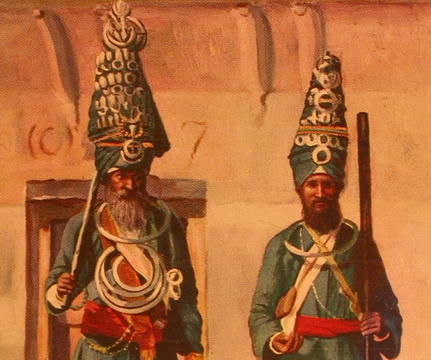
The Chakkar became closely associated with the Sikhs, particularly during the time of Maharaja Ranjit Singh, when it was extensively used by the Nihang warriors. Nihangs were known for wearing Chakkars as part of their attire, often adorning them on their arms, around their necks, or stacked in tiers on their high turbans. This practice, combined with the Sikhs' formidable skills with the weapon, solidified its place in Sikh martial tradition.


Historical accounts, such as those of the Portuguese chronicler Duarte Barbosa in 1516, describe the Chakkar being used in the Delhi Sultanate. He provides a vivid description of the weapon, noting how skilled fighters would carry several Chakkars on their left arm, spinning and hurling them with great precision and dexterity, capable of inflicting serious damage to their enemies.

The effectiveness of the Chakkar in battle depended on its size. Regular steel Chakkars, measuring around 15 centimeters in diameter, could be thrown up to 60 meters, while brass Chakkars, with their superior airfoil design, had a range of over 100 meters. The circular design allowed the weapon to cut through the air without being easily affected by wind, making it highly aerodynamic. In battle, Chakkars were often thrown vertically to prevent accidentally hitting an ally, and warriors could throw them one after another from a stack, similar to shuriken. On horseback or from an elephant, the Chakkar was easier to deploy than arrows or spears, enhancing its utility in warfare.


One of the most iconic methods of throwing the Chakkar is known as tajani. In this technique, the Chakkar is twirled on the index finger of an upraised hand and released with a flick of the wrist. The spinning motion adds both power and range to the throw, while ensuring the wielder doesn't cut themselves on the sharp edge. Skilled warriors could twirl the Chakkar with one hand while simultaneously wielding another weapon. This technique was perfected by the Nihangs, who employed a specific formation to protect the Chakkar-wielder in battle.

The Chakkar came in various sizes, with smaller chakri being worn on the wrists or arms and used like knuckledusters in close combat, breaking or cutting an opponent’s arms while grappling. Larger vada chakras were worn around the neck and could be thrown or dropped vertically onto an opponent. Chakkars worn in the turban could also be used to rake across an enemy’s face or eyes during a fight.

Today, the Chakkar remains a potent symbol in Sikhism, prominently displayed on the Nishan Sahib, the Sikh holy flag that flies outside all gurdwaras (places of worship). The Khanda, a Sikh emblem, incorporates the Chakkar in its design, representing the eternal nature of God. The Chakkar, with its circular form that has no beginning or end, symbolizes the perfection of the divine, embodying the ideals of eternity and timelessness in Sikh theology.


Sikh Nishan Sahib

Wednesday, April 4, 2018

Significance of Falcon or Baaz in Sikhism.


In Sikhism, the falcon, or Baaz, symbolizes the principle of "Sikhan da mann nevan mat uchi," which means "May the Sikhs always remain humble, yet possess sublime wisdom." This representation encapsulates the dual qualities of humility and sharp intellect that every Sikh should strive to embody.


The Tenth Sikh Guru, Guru Gobind Singh Ji, is famously referred to as "Chittey Baaza Vala," or "The Keeper of the White Falcon." The white falcon, in this context, became an iconic symbol of strength, nobility, and vision. Guru Gobind Singh Ji’s association with the Baaz reflects his efforts to instill a sense of dignity, valor, and moral fortitude in his followers. He taught his Sikhs that true worth lies not just in physical strength but also in upholding righteousness with humility and grace.


Guru Gobind Singh Ji's regal bearing was also reflected in the way he conducted himself as an Emperor. Another title bestowed upon him is "Shah-e-Shehanshah," meaning "The King of Kings." This title signified his authority, not in terms of material power, but in spiritual leadership and moral sovereignty. Guru Ji held court (Darbar) where he would meet with both the rich and the poor, treating everyone with the same respect. Whether meeting kings and rajas or the needy, his message remained one of justice, equality, and unwavering courage.

Guru Gobind Singh Ji always appeared fully armed (Shastardhari), with weapons symbolizing his readiness to defend righteousness. He sat on the Takhat (Throne) during his court sessions, exemplifying leadership grounded in both humility and strength. His royal appearance, combined with the grace of the white falcon, created a powerful image that remains deeply etched in the hearts of Sikhs.

The image of Guru Gobind Singh Ji, adorned with a sword, quiver of arrows, and shield, wearing a Kalgi (royal plume) on his turban, and holding the white falcon, is a vivid and potent symbol for Sikhs. This imagery not only represents his martial prowess but also his dedication to protecting the oppressed, guiding his followers toward justice, and inspiring them to live with both courage and humility. The falcon, perched on his arm, serves as a reminder of the balance between power and wisdom, embodying the values he imparted to his Sikhs.

Wednesday, March 7, 2018

What is Khalsa Army.

"Khalsa Akaal Purakh Ki Fauj" translates to "The Khalsa is the army of the Almighty," a phrase originating from the words of Guru Gobind Singh Ji, the tenth Sikh Guru. The concept of the Khalsa, established by Guru Gobind Singh, represents the ideal of the Sant-Sipahi, or Saint-Soldier, whose duty is not only to protect but also to serve humanity, transcending religious or social boundaries. The Khalsa's role is to embody and act upon the teachings of the Sikh Gurus, rooted in charity, love, and service to all.

The Purpose of the Khalsa

Guru Gobind Singh Ji established the Khalsa in 1699 with a clear and powerful mission: to act as the army of God, defending the rights and freedoms of everyone, not just Sikhs. The Khalsa is meant to uphold justice, stand against oppression, and always adhere to the ethical principles laid out in the Sri Guru Granth Sahib, the central religious scripture of Sikhism.

The Khalsa's duties are vast and encompass more than just military defense. The Khalsa is expected to serve the greater good, to live a life in accordance with Gurbani (the Guru's teachings), and to embody the virtues of humility, love, and selfless service. This mission of serving the world requires a universal approach, where the Khalsa reaches out to all of humanity, not limiting their service to a particular community, belief system, or group.

The Responsibilities of the Khalsa

Being part of the Khalsa is not merely a religious title; it comes with immense responsibilities. As Guru Gobind Singh Ji emphasized, the Khalsa is meant to serve all of humanity. If the Khalsa begins to narrow its focus and serves only a select few, it strays from its path and fails in its duties to the Guru and God. The Guru’s vision for the Khalsa is to be a force that uplifts, defends, and cares for the entire world.

Guru Gobind Singh Ji laid out this vision clearly, stating:

"Khalsa is God's Army. It is sustained by the Will of the Almighty. While the Khalsa remains pure, I will give it all my strength. But if it begins to follow the wrong path, I will no longer offer my support."

These words remind the Khalsa that its strength lies in purity, in following the righteous path of God, and in selfless service. The moment the Khalsa begins to act selfishly or imitate the ways of those who stray from righteousness, it loses its divine support and purpose.

Khalsa and Hukam: Following God's Command

In Sikh philosophy, Hukam refers to the command or divine will of God, also referred to as Akal Purakh. For the Khalsa, following Hukam is essential to their identity. As outlined in the Sikh scripture, Japji Sahib, one must walk in the path of Hukam meaning to live in harmony with God's will and to accept both joy and sorrow with grace.

The Khalsa, as soldiers of Akal Purakh, must adhere strictly to this divine command. A person who runs away from Hukam, who seeks to avoid their responsibilities, cannot be considered part of the Khalsa. The Khalsa is tasked with protecting both themselves and others from evil, standing up for truth and justice, and always acting under the command of the Almighty.

The Legacy of the Khalsa

Guru Gobind Singh Ji created the Khalsa as a powerful symbol of divine strength and spiritual purity. The Khalsa is not merely a group of warriors but a community of individuals who have dedicated their lives to serving humanity and following the will of God. In doing so, they exemplify the virtues of a Saint-Soldier, living a life that balances spiritual devotion with the courage to defend those who cannot defend themselves.

The true power of the Khalsa lies not just in its martial strength but in its commitment to the broader principles of justice, equality, and service. Only when the Khalsa serves the entire world, without bias or selfish motives, can it truly fulfill its role as "Akaal Purakh Ki Fauj," the army of the Almighty.


Baba Banda Singh Bhadur leading Khalsa Army in battle of Sirhind in 1710.

Saturday, March 22, 2014

Role and equality of Women in Sikhism

Sikhism, founded by Guru Nanak Dev Ji in the 15th century, has always been a progressive religion when it comes to the treatment and equality of women. From its inception, Sikhism promoted the idea that men and women are equal in all aspects of life. One of Guru Nanak Dev Ji's most profound teachings on gender equality is captured in his words:

"We are conceived and born from women. Woman is our life-long friend and keeps the race going. Why should we despise her, the one who gives birth to great kings?"

In Sikhism, women enjoy the same rights and privileges as men, both in religious and secular life. They are regarded as possessing the same soul as men and have the right to grow spiritually and intellectually. Sikh women are not seen as subordinate but as equal partners in the journey toward spiritual enlightenment and personal growth.

Religious Equality and Participation

A woman in Sikhism has the right to fully participate in all religious activities, just like her male counterparts. She can lead religious congregations, perform Kirtan (the singing of devotional hymns), and partake in Akhand Path, the continuous recitation of the Guru Granth Sahib. Furthermore, a Sikh woman can serve as a Granthi (priest) or preacher, and play an active role in spiritual leadership. In the Sikh Gurdwaras (places of worship), women sit side by side with men, reflecting the religion's core belief in gender equality.

Historical Figures of Sikh Women

Sikh history is filled with examples of courageous and influential women who shaped the course of events in their time. These women demonstrated that leadership and bravery are not limited by gender.

One of the most prominent figures in Sikh history is Mai Bhago (Mata Bhag Kaur), a warrior who led Sikh soldiers into battle against the Mughal army in 1705. Her bravery and leadership have been an inspiration to generations of Sikh men and women. 

 Mai Bhago (Mata Bhag Kaur) led Sikh Army in 1705 against Mughals.


Other influential women in Sikh history include Mata Gujri, the mother of Guru Gobind Singh ji, Mata Sundari, Rani Sahib Kaur, Rani Sada Kaur, and Maharani Jind Kaur, all of whom played significant roles in shaping the Sikh community.

These women, through their courage, wisdom, and resilience, have left an indelible mark on Sikh history, demonstrating that women are just as capable of leadership and heroism as men.

Challenging Social Injustices

The Sikh Gurus were vocal in their opposition to the social injustices faced by women in their time. They stood against practices that degraded women, such as sati (the ritual of burning a widow alive on her husband’s funeral pyre), female infanticide, and the wearing of the veil.

Sati, in particular, was becoming more common due to the influence of certain cultural practices. The Sikh Gurus strongly condemned this ritual and instead emphasized that a true sati is not a woman who dies on the pyre but one who lives a life of honor and integrity, cherishing her late husband's memory without self-harm.

As stated in Guru Granth Sahib:
"A sati is not the one who burns herself on the pyre.
Sayeth Nanak, a true sati dies of the shock of demise."

(Guru Granth Sahib, p. 787)

This teaching reflects the Gurus’ progressive stance on women's rights and their advocacy for women's dignity in society.

The Modern Sikh Woman

In today’s world, Sikh women continue to thrive in various fields, making significant contributions to society. Whether in politics, business, education, or the military, Sikh women have established themselves as leaders and trailblazers. In India and across the globe, they have achieved success in diverse fields, serving as an example of the empowerment and equality that Sikhism champions.

Sikh women are not only succeeding professionally but are also maintaining their commitment to the values of service (seva) and spirituality. Many women actively participate in community service, organizing langars (community kitchens), and contributing to the well-being of their communities while balancing their roles as professionals and family members.

Wrap Up!

Sikhism stands out as a faith that, from its very origins, has supported the equality of women. By granting women the same rights as men in religious, social, and cultural spheres, Sikhism has empowered women to be active participants in all aspects of life. Whether through historical figures like Mai Bhago or the countless modern Sikh women who continue to inspire and lead, the legacy of gender equality in Sikhism remains strong and vibrant.

Friday, March 21, 2014

What are Sikh Belief?


Sikhism is a monotheistic religion founded in the Punjab region of India in the 15th century. It emphasizes the belief in one God and the importance of living a truthful and meaningful life. Central to Sikhism is the understanding that God is without form or gender, and that all individuals, regardless of their background, have direct access to the divine. Let’s explore the key beliefs and practices that shape the Sikh faith.

The Nature of God

Sikhs believe there is only one God, an eternal and formless presence that transcends all human limitations. This divine being, also known as Waheguru, is not confined to any gender or physical form. God is present in every part of creation, and everyone is equal before Him. The Sikh philosophy teaches that no one is closer or further from God based on status, race, or gender.

Living a Good Life

In Sikhism, living a good life means living with honesty, caring for others, and serving the community. The Sikh ideal combines belief with action. Rather than focusing on empty rituals or superstitions, which have no value in Sikh teachings, Sikhs are encouraged to live with sincerity. A good life is one that reflects inner devotion to God while also contributing positively to the community. Meditating on God's name (Nam Japna) and performing good deeds are equally important for spiritual growth.

The Cycle of Life and Karma

Like other Indian religious traditions such as Hinduism and Buddhism, Sikhs believe in the cycle of birth, life, death, and rebirth. This cycle, known as samsara, continues until a soul attains liberation or mukti. A person’s actions in their current life, governed by the law of Karma, determine the quality of their next life. Good deeds lead to positive outcomes in the next life, while bad actions result in a less favorable existence. However, the ultimate goal of life is to break free from this cycle and unite with God, which can only happen through the grace of God.

Achieving Liberation through God’s Grace

For Sikhs, the journey towards liberation is not something one can achieve solely through personal effort. It is believed that God’s grace, or kirpa, is necessary to reach a state of mukti, where the soul merges with God. To prepare for this grace, a Sikh must turn their attention away from worldly distractions and focus on God. This is done through prayer, meditation, and following the teachings of the Sikh Gurus, who provide guidance on how to live a life centered on divine love.

Truth and Honest Living

Sikhs value truth as the highest virtue. Yet, even more important is living a truthful life. They believe that God cannot be fully understood by the human mind, but He can be experienced through love, worship, and contemplation. Sikhs seek to find God not only in the world around them but also within themselves, as they strive for liberation and union with the divine.

Serving Others

Sikhism encourages individuals to see God both within themselves and in the broader world. One of the most important ways Sikhs honor God is through service, or seva. A Sikh’s duty is to serve others selflessly, whether by feeding the hungry in the langar (community kitchen), caring for the sick, or engaging in charitable activities. By serving others, Sikhs work to overcome ego and pride, which are barriers to spiritual growth.

The Three Duties of a Sikh

Sikh teachings emphasize three key duties, which can be summed up as Nam Japna, Kirt Karna, and Vand Chhakna.

  1. Nam Japna: This involves keeping God in mind at all times through prayer and meditation.
  2. Kirt Karna: Sikhs are expected to earn an honest living. This means not only avoiding dishonest activities but also steering clear of industries associated with harm, such as alcohol, tobacco, and gambling.
  3. Vand Chhakna: Sharing one’s earnings with others is a key principle of Sikhism. Sikhs are encouraged to give to charity and support those in need.

Avoiding the Five Vices

Sikhs strive to avoid five vices that can lead to a self-centered life and distance them from God. These vices are:

  1. Lust
  2. Greed
  3. Attachment to material things
  4. Anger
  5. Pride

By overcoming these vices, Sikhs believe they can progress on the path to liberation.

Wrap Up!

Sikhism promotes a balanced life where devotion to God is intertwined with service to humanity. It calls for living honestly, overcoming ego, and treating everyone with equality and respect. Through these principles, Sikhs aim to live in harmony with the divine and ultimately achieve liberation through God’s grace.

Gatka - A Sikh Martial Art


Martial arts hold a significant place in the cultural history of many nations, and India is no exception. The country boasts a rich tradition of combat styles that reflect its diverse history and cultural heritage. One such martial art, deeply rooted in the northwestern region of India, is Gatka. Associated primarily with the Sikhs of Punjab, Gatka is a weapon-based martial art that has gained recognition for its unique blend of spirituality and combat techniques.

Origins and Evolution of Gatka

Gatka (Punjabi: ਗਤਕਾ) is more than just a combat technique—it is a spiritual practice intertwined with the history of the Sikh community. The term Gatka originally referred to the wooden sticks used in sparring, and it is believed to be derived from the Sanskrit word khadga, meaning sword. Some also link its origin to the Persian word khat. While Gatka is primarily a weapon-based martial art, it incorporates aspects of pehlwani, a form of wrestling, into its unarmed combat techniques.

The martial art traces its roots to the ancient fighting techniques of the Punjab region, which today spans parts of both India and Pakistan. These combat methods, collectively known as shastar vidiya (the science of weapons), were practiced by various groups, including the Rajputs, Gurjaras, and the Kshatriya caste. Shastar vidiya was originally focused on sword fighting but later expanded to include a variety of armed combat techniques.

Sikh Influence and Development

The rise of Gatka as a prominent martial art is closely tied to the Sikh religion, particularly during the leadership of Guru Nanak, the founder of Sikhism. Guru Nanak was born into the Kshatriya warrior caste, as were many of his early disciples. He, along with his successors, encouraged the practice of martial arts as a means of not only physical but also mental and spiritual development. His teachings laid the foundation for the Sikh martial tradition that would evolve over the coming centuries.

Guru Hargobind, the sixth Sikh Guru, played a pivotal role in shaping the warrior-saint ideal that would become central to Sikhism. He emphasized the importance of martial training for self-defense, particularly in response to the oppressive Mughal rule under Emperor Aurangzeb. It was during this period that Gatka and other martial arts became crucial for the survival of the Sikh community, as they resisted forced conversions to Islam.

Guru Gobind Singh, the tenth Sikh Guru, is considered a master of shastar vidiya and played a decisive role in organizing and formalizing Sikh martial traditions. In 1699, he founded the Khalsa, a brotherhood of Sikh warriors dedicated to fighting oppression and defending the faith. The Khalsa were trained in the art of Gatka and other combat techniques, symbolized by the kirpan (dagger), one of the five Ks that baptized Sikhs are required to carry. Guru Gobind Singh’s famous pledge to "teach the sparrow to fight the hawk" reflects his commitment to empowering his followers to defend themselves against stronger opponents.

Impact of Colonialism and Revival

The arrival of the British in India had a significant impact on Gatka and other traditional martial arts. Following the Second Anglo-Sikh War (1848-1849), the British colonial authorities sought to suppress Sikh martial traditions, fearing potential rebellion. The Akali Nihangs, who were considered the custodians of Sikh martial culture, were particularly targeted, and many were killed or forced to flee to remote regions.

Despite these efforts, Gatka experienced a resurgence after the Indian Rebellion of 1857, during which Sikhs had allied with the British to suppress the uprising. As a result, some of the restrictions on Sikh martial practices were eased, and Gatka began to reemerge, albeit in a modified form. The techniques of sword fighting were adapted to the use of wooden sticks, and the art evolved into what is now known as khel or sport Gatka, incorporating elements of European fencing into its training methods.

Modern Practice of Gatka

Today, Gatka is practiced by Sikh communities not only in India but also in countries with significant Sikh populations, such as Malaysia, Hong Kong, and Thailand. It remains a vital part of Sikh heritage, serving as both a physical discipline and a spiritual practice. In its modern form, Gatka is often performed during religious and cultural festivals, most notably during the Sikh festival of Hola Mohalla, where practitioners demonstrate their skills in front of large crowds.

While Gatka has undergone transformations over the centuries, its core values of discipline, self-defense, and spiritual connection remain intact. It continues to symbolize the resilience and martial spirit of the Sikh community, preserving the legacy of its warrior-saints for future generations.

Holla Mohalla


Hola Mohalla is a grand annual fair held in Anandpur Sahib, Punjab, the day after the festival of Holi. This tradition was initiated by Guru Gobind Singh, the tenth Sikh Guru (1666-1708), with the aim of empowering the Sikh community through physical training and mock military exercises.

The festival spans three vibrant days, where Sikhs showcase their strength and courage through breathtaking acts like bareback horse-riding, standing upright on two galloping horses, Gatka (the traditional Sikh martial art), and tent pegging. These awe-inspiring displays are followed by music and poetry competitions, adding a sense of cultural celebration to the energetic atmosphere.

Spiritual gatherings also form an essential part of Hola Mohalla. Durbars are held with the presence of Sri Guru Granth Sahib, where Kirtan and religious discourses are conducted, providing spiritual nourishment to the community. On the final day, a grand procession, led by the Panj Pyaras (Five Beloved Ones), begins at Takht Keshgarh Sahib, one of the five seats of Sikh authority. The procession passes through significant Gurdwaras such as Qila Anandgarh, Lohgarh Sahib, and Mata Jitoji before returning to the Takht.


Visitors to Anandpur Sahib during Hola Mohalla are welcomed with langars (community kitchens), organized by locals as part of their seva (selfless service). Villagers generously contribute ingredients like wheat flour, rice, vegetables, milk, and sugar, while women volunteers prepare traditional meals. Pilgrims sit in rows on the ground, enjoying the delicious food in the spirit of unity and humility.


Hola Mohalla is not just a festival of physical prowess; it’s a celebration of the Sikh values of service, strength, and spirituality, embodying the vibrant culture and deep-rooted traditions of the community.    

Sikhs are showing dare-devil act during Hola Mohalla.